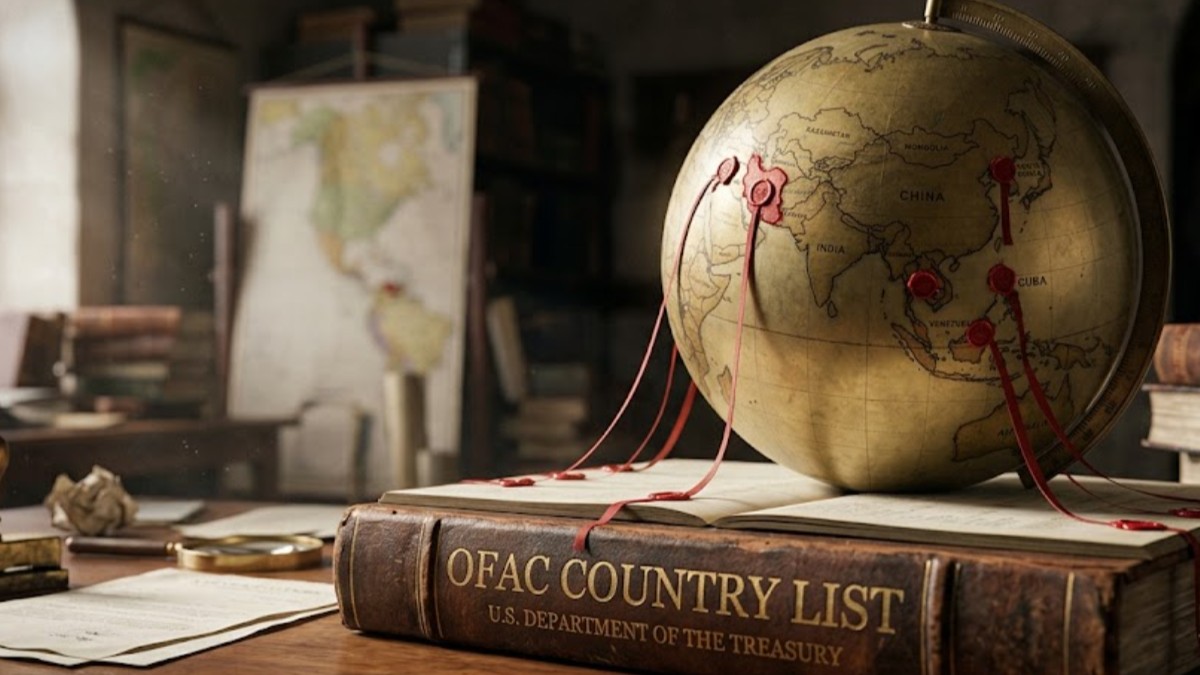
Countries sanctioned by the United States are those subject to active economic sanctions programs administered by the Treasury Department’s Office of Foreign Assets Control (OFAC).
As of May 2026, OFAC maintains 37 active sanctions programs, according to the official list published on ofac.treasury.gov. Some impose near-total embargoes (Cuba, Iran, North Korea). Others restrict specific economic sectors (Russia, Venezuela). Others designate specific persons and entities regardless of nationality.
The list changes frequently. In 2025 and 2026 there have been far-reaching changes: the revocation of the comprehensive Syria program in July 2025, the repeal of the Caesar Act in December 2025, the new executive order on Cuba of May 2026 with secondary sanctions against foreign institutions, and adjustments to the Russia and Venezuela programs.
A non-U.S. company that deals with any of these countries is exposed if there is any U.S. jurisdictional nexus, in the case of primary sanctions, or if it deals with sanctioned sectors or persons even without a U.S. nexus, in the case of secondary sanctions.
What Does It Mean for a Country to Be Sanctioned by OFAC?
A country being sanctioned by OFAC means there is a specific Office of Foreign Assets Control program that restricts transactions with that country, its government or related entities. The scope of the restrictions varies by program: they can be a full embargo, a sectoral limitation or the designation of specific persons and entities.
There are three main types of sanctions programs, with different legal and operational consequences for a non-U.S. company.
Comprehensive sanctions. They prohibit virtually all transactions with the country, its government and its residents. They are the most restrictive. Dealings are only possible under a general or specific license issued by OFAC. This is the case of Cuba, Iran, North Korea and the regions of Ukraine occupied by Russia.
Sectoral sanctions. They restrict economic activity with specific strategic sectors of the country without imposing a total embargo. Trade outside those sectors remains lawful. This is the case of Russia (energy, finance, defense), Venezuela (oil) and Belarus.
List-based sanctions. They do not restrict an entire country but designate individuals and entities on the SDN List or other OFAC lists. The nationality or location of the designated party is not what matters: what is decisive is that it appears on the list. Programs such as Global Magnitsky, Counter Terrorism and Counter Narcotics work this way.
For a more detailed analysis of the structure and authority of OFAC sanctions programs, see our complete OFAC guide.
Complete List: The 37 Active OFAC Sanctions Programs in 2026
OFAC administers 37 active sanctions programs as of May 2026, organized by country, region or type of activity. The following table lists each program with the date of its last official update, according to the public record on ofac.treasury.gov.
| OFAC program | Last updated |
|---|---|
| Afghanistan | Feb 2022 |
| Balkans | Nov 2025 |
| Belarus | Mar 2026 |
| Burma (Myanmar) | Nov 2025 |
| Central African Republic | Dec 2023 |
| Chinese military companies | Jun 2022 |
| Counter narcotics | May 2026 |
| Counter terrorism | May 2026 |
| CAATSA (Countering America’s Adversaries) | Feb 2026 |
| Cuba | May 2026 |
| Cyber-related | Apr 2026 |
| Democratic Republic of the Congo | Apr 2026 |
| Ethiopia | Feb 2022 |
| Foreign interference in U.S. elections | Dec 2024 |
| Global Magnitsky | Mar 2026 |
| Hong Kong | Mar 2025 |
| Hostages and wrongful detention | Mar 2025 |
| International Criminal Court | Dec 2025 |
| Iran | May 2026 |
| Iraq | Jul 2025 |
| Lebanon | Feb 2026 |
| Libya | Sep 2025 |
| Magnitsky | Aug 2023 |
| Mali | Aug 2023 |
| Nicaragua | Apr 2026 |
| Nonproliferation | May 2026 |
| North Korea | Mar 2026 |
| PAARSS (post-Assad Syria) | Dec 2025 |
| Rough diamonds | Jun 2018 |
| Russian harmful foreign activities | Apr 2026 |
| Somalia | May 2023 |
| South Sudan | Dec 2023 |
| Sudan and Darfur | Apr 2026 |
| Transnational criminal organizations | Dec 2025 |
| Ukraine/Russia | May 2026 |
| Venezuela | May 2026 |
| Yemen | Nov 2021 |
Source: OFAC, Sanctions Programs and Country Information, accessed in May 2026.
Countries Under Comprehensive Sanctions: Near-Total Prohibition
Comprehensive sanctions prohibit virtually all transactions with a country, its government and its residents, unless expressly licensed by OFAC. There are four active comprehensive programs in 2026: Cuba, Iran, North Korea and the regions of Ukraine occupied by Russia.
Cuba
The Cuba program has combined two regimes since May 2026. The first is the traditional embargo, governed by the Cuban Assets Control Regulations (CACR, 31 CFR 515), in force since 1963, which prohibits U.S. persons from virtually any transaction with Cuba, its government or its residents. The second is Executive Order 14404, signed on May 1, 2026, which creates a parallel authority under IEEPA with two developments that are critical for non-U.S. companies.
EO 14404 allows the designation of foreign persons operating in specific sectors of the Cuban economy and introduces secondary sanctions against foreign entities, financial or otherwise, that engage in transactions with government entities or designated parties. On May 7, 2026, OFAC designated Grupo de Administración Empresarial S.A. (GAESA), the military conglomerate that controls approximately 40% of the Cuban economy, along with other regime entities.
For a European, Latin American or other non-U.S. company, this means that any transaction with GAESA —which, in addition to being designated, is a state entity— or with any of its subsidiaries, directly or indirectly, carries a risk of sanctions. OFAC granted a wind-down period until June 5, 2026 to close out existing transactions. Foreign subsidiaries of U.S. companies are also required to comply with the pre-existing Cuban embargo under 31 CFR 515.329.
Iran
Iran is the broadest sanctions program administered by OFAC and involves a near-total embargo. The Iranian Transactions and Sanctions Regulations (ITSR, 31 CFR 560) prohibit U.S. persons from exporting, reexporting, selling or supplying goods, technology or services to Iran or the Government of Iran, directly or indirectly.
Non-U.S. persons are also prohibited from the same activities under primary sanctions where there is a U.S. nexus.
The Iran program is especially relevant to non-U.S. companies for additional reasons. Foreign subsidiaries controlled by U.S. companies are expressly subject to the program (31 CFR 560.215). In addition, there are broad secondary sanctions: the Treasury Department can sanction foreign persons for transactions with designated sectors of the Iranian economy, including oil, banking and defense.
Likewise, as in most programs, non-U.S. entities that deal with sanctioned parties are exposed to secondary sanctions.
In May 2026, OFAC continued to expand designations of persons linked to the Iranian network, particularly in the energy and financial sectors, the drone (UAV) program and the military apparatus of the Islamic Revolutionary Guard Corps.
North Korea
The North Korea program imposes a near-total embargo under the North Korea Sanctions Regulations (31 CFR 510). U.S. persons are prohibited from any transaction with North Korea, its residents or entities linked to the regime, unless expressly licensed.
These primary sanctions also apply to non-U.S. entities where there is a U.S. nexus.
OFAC blocks by default the assets of the North Korean government and of virtually every person designated under this program. Secondary sanctions are particularly intense: any foreign financial institution that processes significant transactions on behalf of designated persons risks losing access to the U.S. banking system. The program also extends certain restrictions to foreign subsidiaries controlled by U.S. financial institutions (31 CFR 510.214).
For non-U.S. companies, the main risk comes from Asian supply chains. Components manufactured in China, U.S.-origin software diverted through third countries, and financial services passing through U.S. correspondent banks have been recurring routes to non-compliance.
Occupied Regions of Ukraine: Crimea, Donetsk, Luhansk, Kherson and Zaporizhzhia
The restrictions on the Ukrainian territories occupied by Russia do not operate as a country program but as a geographic program. Under Executive Order 13685 (Crimea, 2014) and subsequent expansions to Donetsk, Luhansk, Kherson and Zaporizhzhia (2022 onward), OFAC prohibits U.S. persons from importing from, exporting to and investing in those regions, as well as from financing transactions there.
The same restrictions apply under primary sanctions to non-U.S. entities where there is a U.S. nexus.
For a non-U.S. company, the risk under primary sanctions arises when the transaction touches the U.S. financial system (dollar payments, correspondent banking) or when it incorporates U.S.-origin goods, software or technology. OFAC has repeatedly penalized foreign entities that used banking platforms connected to the United States to process payments linked to these regions.
Countries Under Sectoral Sanctions: Restrictions by Industry
Sectoral sanctions restrict economic activity with specific strategic sectors of a country without imposing a total embargo. They allow trade with the country outside the sanctioned sectors but require very precise due diligence on the nature of the transaction and the counterparty.
Russia
The Russia program is the most dynamic and volatile of the active programs in 2026. It combines the Russian Harmful Foreign Activities Sanctions (EO 14024, 2021) with the earlier Ukraine/Russia-Related Sanctions (EO 13660 et seq., since 2014). It restricts the energy, financial, defense, metallurgical and technology sectors and other sectors specifically identified by the Treasury.
Its intensity has fluctuated in recent months. In October 2025, the Treasury designated Russia’s two largest oil companies, Rosneft and Lukoil, to pressure the Kremlin into accepting ceasefire negotiations. In March 2026, OFAC removed the designation of several individuals close to the Russian government, in what was interpreted as a concession linked to the diplomatic talks. General licenses on Russian oil have been renewed periodically with short deadlines.
The Russia foreign direct product rule (FDPR) is particularly relevant to non-U.S. companies: any semiconductor produced outside the United States with U.S. technology or equipment may be subject to export controls administered by BIS if its final destination is Russia. The program also has active secondary sanctions against foreign institutions that support the Russian military-industrial base (EO 14114, December 2023).
Venezuela
The Venezuela program focuses mainly on the oil sector and on individual designations of officials and entities linked to the government of Nicolás Maduro. The governing authority is Executive Order 13808 (2017) and its subsequent expansions.
Throughout 2025 and 2026, OFAC has issued and amended several general licenses on the Venezuelan oil sector, initially to manage the orderly exit of U.S. companies that still had residual operations and to authorize specific humanitarian transactions. Following the capture and transfer of Nicolás Maduro to the United States, OFAC has issued a series of general licenses that, while keeping the structure of the sanctions on the energy and mining sectors, authorize broad participation in those sectors subject to strict compliance with the various license conditions, which place these operations under U.S. control. For non-U.S. companies with operations in extractive or financial sectors in Venezuela, the main exposure comes from transactions involving designated parties or payments passing through the U.S. financial system that do not meet the conditions of the applicable general licenses.
Belarus
Sanctions against Belarus have expanded in parallel with those against Russia since 2022, in response to the logistical and military support provided to the Kremlin. They restrict the financial, energy, defense and technology sectors. The last significant update to the program dates from March 2026, with new designations against companies close to the presidency and intermediary entities in the evasion of Russia sanctions.
Myanmar (Burma)
The Myanmar program was reactivated after the military coup of February 2021. It restricts the mining sector —especially jade and gold—, the energy sector (including the state oil and gas company MOGE) and persons linked to the military junta. Companies with metal or gemstone supply chains have particularly high exposure.
Syria: PAARSS and the End of the Comprehensive Program
Syria ceased to have a comprehensive sanctions program on July 1, 2025. Executive Order 14312, signed by President Trump on June 30, 2025, revoked the six executive orders that formed the basis of the Syria program, terminated the underlying national emergency and repealed the Syrian Sanctions Regulations (31 CFR 542). OFAC removed 518 persons and entities from the SDN List.
The residual program is called PAARSS (Promoting Accountability for Assad and Regional Stabilization Sanctions) and maintains list-based sanctions on Bashar al-Assad, associates of the former regime, human rights abusers, Captagon traffickers, persons linked to the weapons of mass destruction program and Iranian proxies. In December 2025, Congress repealed the Caesar Act, removing the threat of mandatory secondary sanctions on anyone supporting the Syrian government. In September 2025, the Bureau of Industry and Security (BIS) substantially relaxed EAR export controls on Syria.
The practical result is that the Syrian market has opened up to non-U.S. companies, but with significant residual risks: counterparty due diligence remains mandatory, since the PAARSS program is still active and OFAC retains the power to investigate violations of the former SySR that occurred before July 1, 2025.
Other List-Based Programs Relevant to Non-U.S. Companies
List-based sanctions do not restrict an entire country but designate specific persons and entities on the SDN List or other lists, regardless of nationality. A European or Latin American company can be exposed even when dealing with a country that has no program of its own if its counterparty is designated under one of these thematic programs.
Some of the most relevant are the following. Global Magnitsky designates those responsible for significant corruption and serious human rights abuses anywhere in the world. Counter Terrorism and Counter Narcotics Trafficking continuously add designated organizations and financiers to the SDN List. Transnational Criminal Organizations includes Latin American cartels designated in 2025. International Criminal Court-Related Sanctions, created in 2025, allows sanctions against persons who cooperate with ICC investigations of U.S. or Israeli citizens; it particularly affects European companies with institutional ties to the Court. There are also geographic programs on Nicaragua, Lebanon, Iraq, Yemen and Sudan, all list-based.
Secondary Sanctions: The Main Risk for Non-U.S. Companies
Secondary sanctions allow the United States to sanction foreign persons —even without any nexus to the country or its financial system— for transactions with designated persons or with strategic sectors of sanctioned countries. They are the main route by which a non-U.S. company can end up designated on the SDN List while dealing only with non-U.S. counterparties.
The programs with the most active secondary sanctions in 2026 are Iran, North Korea, Russia and, since May 2026, Cuba. EO 14404 on Cuba follows the same architecture as EO 14114 on Russia: it empowers the Treasury to sanction foreign financial institutions (FFIs) that facilitate significant transactions with designated persons. The concept of a “significant transaction” is not defined in the regulations and depends on factors such as size, frequency, complexity, economic benefit conferred on the designated party and the use of deceptive practices.
Secondary sanctions do not only affect financial institutions. They can involve any type of entity operating in sanctioned sectors or with sanctioned parties.
The full scope of how U.S. sanctions affect non-U.S. companies is developed in our article on the extraterritorial reach of U.S. sanctions.
Most Exposed Business Sectors
The sectors most exposed to OFAC sanctions are finance, energy, defense, technology and semiconductors, and logistics and transportation. This concentration of risk reflects the logic of the programs: where international trade is most sensitive, controls are densest.
The financial sector accounts for the largest number of enforcement actions related to secondary sanctions, especially correspondent banks, payment platforms and cryptocurrency exchanges. The energy sector is central to the Russia, Venezuela and Iran programs, with specific restrictions on oil, gas and related technical services. The defense and aerospace sector is subject to OFAC controls as well as ITAR and EAR controls, which multiplies the possible points of failure. The technology sector, particularly semiconductors and dual-use software, is covered by the Russia FDPR and by specific restrictions on Chinese entities on the BIS Entity List. The logistics and maritime transportation sector has recently been the scene of several OFAC actions against companies that moved cargo indirectly linked to sanctioned destinations.
Consequences of Dealing with a Sanctioned Country
The consequences of dealing with a sanctioned country are civil, criminal and operational, and they can occur simultaneously in the same case. The regime is one of strict liability: a company can be penalized civilly even if it had no intention of violating the rules.
The maximum civil penalty under IEEPA is $377,700 per violation, or twice the value of the transaction if that amount is greater, according to the current figure published in 31 CFR 501 Appendix A for 2025-2026. In cases with multiple violations, penalties accumulate for each prohibited transaction. Willful violations are federal crimes punishable by up to 20 years in prison and criminal fines of up to $1 million per violation under 50 U.S.C. § 1705. Operational consequences include the blocking of accounts at U.S. banks, loss of access to the U.S. financial system, designation of the company itself on the SDN List and reputational damage that can lead to the loss of U.S. customers and suppliers.
A full analysis of the consequences of violating OFAC sanctions covers each enforcement route with OFAC cases against non-U.S. companies.
Case Study: How a European Company Assesses Its Exposure to Sanctioned Countries
A European industrial company with a sales subsidiary in Dubai distributes technical equipment to customers in Central Asia and the Middle East. The European headquarters has no direct relationship with customers in sanctioned countries. The Dubai subsidiary, however, sells to a local distributor that, without the parent company’s express knowledge, reexports part of the product to end customers in Iran.
The company’s real exposure is multiple. First, the distributor’s payments to the Dubai subsidiary are processed in dollars through U.S. correspondent banks, which triggers OFAC jurisdiction under primary sanctions. Second, part of the equipment incorporates controlled U.S.-origin software above the 10% de minimis threshold applicable to destinations in Iran, which also triggers the EAR. Third, the European parent company may end up penalized under the Iran program for “causing” the export of services or goods from the United States to a prohibited destination, even without knowledge.
In the worst case, if the end user is a designated entity or operates in a sanctioned sector, the European company could be designated under secondary sanctions.
Due diligence when engaging the distributor —SDN screening, contractual clauses prohibiting reexport to sanctioned destinations, monitoring of payments and shipments— would have substantially reduced the risk.
In its Guidance On Transhipment To Iran, OFAC warns that sales to Iran are prohibited not only when the final destination is expressly known, but also when there is “reason to know” that this may be the case based on industry knowledge and experience, the relationship with the direct customer and other specific circumstances. In the Apollo Aviation case, the seller had included compliance clauses in the contract but took no additional measures to prevent the products from ending up in prohibited countries.
Frequently Asked Questions
Does my Spanish company have to comply with OFAC if it does not operate in the United States?
A Spanish company is not required to comply with OFAC simply because it is a Spanish company, but it is subject to U.S. primary sanctions if any of the following nexuses is present: it makes dollar payments processed by U.S. correspondent banks, uses U.S.-origin goods or technology, has executives or partners with U.S. citizenship or a green card, or is a subsidiary controlled by a U.S. company. Extraterritoriality operates through these nexuses, not through the company’s nationality.
Under secondary sanctions, a Spanish company incurs risk if it operates in sanctioned sectors or with sanctioned parties, even without a U.S. jurisdictional nexus.
Can I legally deal with Cuba or Iran if I obtain a license?
Yes. OFAC issues two types of authorizations that allow transactions that would otherwise be prohibited. General licenses authorize specific categories of transactions without the need for an individual application (for example, humanitarian assistance, personal financial transactions or the export of medicines, or the recent authorizations to operate in Venezuela’s energy sector or to buy Russian oil). Specific licenses are individual authorizations issued at the request of the operator and require a formal application to OFAC with a detailed description of the transaction, the parties involved and the flow of funds. Approval is not automatic and depends on the program, the type of transaction and current foreign policy.
How do I check whether a counterparty is sanctioned by OFAC?
Screening is done using the Sanctions List Search tool at sanctionssearch.ofac.treas.gov, which covers the SDN List and the consolidated non-SDN lists. The system uses fuzzy-logic search to detect spelling variations. Professional screening should also cover the customer’s addresses, tax identifiers, citizenships and geolocation data. A single probable match must be escalated to the compliance officer before proceeding with the transaction.
It is also necessary to analyze the ownership and control structure to determine whether an unlisted entity is sanctioned because it is owned 50% or more by sanctioned persons.
What do I do if I discover that I have already dealt with a sanctioned entity?
Stop the transaction immediately, preserve all documentation and consider filing a Voluntary Self-Disclosure (VSD) with OFAC. Voluntary self-disclosure can significantly reduce the applicable civil penalty —in some cases by up to 50% of the base amount— under the Economic Sanctions Enforcement Guidelines (31 CFR 501 Appendix A). The decision to self-disclose should be made with specialist sanctions guidance and before OFAC learns of the violation through another channel.
How often do the countries sanctioned by OFAC change?
The programs change frequently. OFAC publishes designations and amendments practically every week, and the most active programs in 2026 —Iran, Russia, Venezuela, Cuba— receive updates several times a month. The most far-reaching changes, such as the revocation of the Syria program in 2025, the recent general licenses for Venezuela or the new executive order on Cuba in May 2026, are less frequent but substantially change the landscape. Any compliance program should provide for periodic reviews and subscription to OFAC’s official alerts.
Free download: OFAC/EAR/ITAR Risk Checklist (in Spanish)
Does your company deal with any of the countries sanctioned by OFAC, or with counterparties that do? Assess your real exposure with this free checklist, designed by Burke Compliance for executives who are not U.S. sanctions specialists.
Last updated: May 2026. OFAC sanctions programs change frequently. Always check the status of the applicable program on ofac.treasury.gov before any critical transaction.
Related service. If this issue affects your company, at Burke Compliance we analyze it as part of our economic sanctions (OFAC) service.