
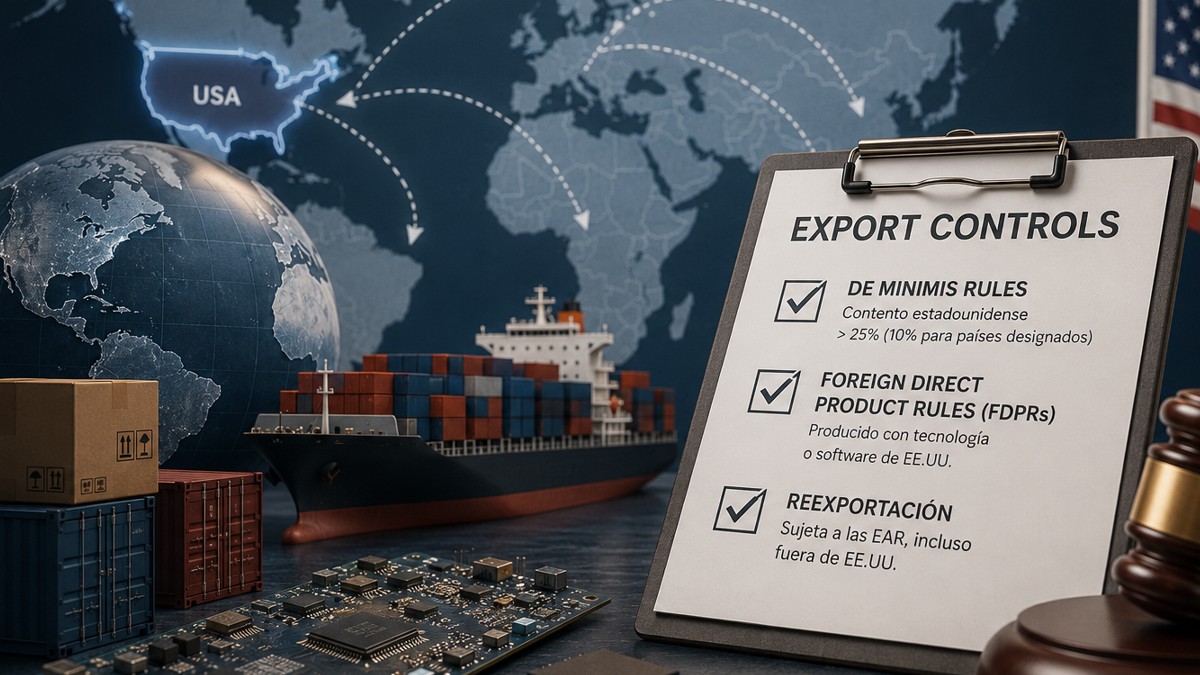
A reexport under the U.S. Export Administration Regulations (“EAR”) is the shipment of an item subject to the EAR from a foreign (non-U.S.) country to a third country. The EAR can apply to a non-U.S. company even if the transaction never touches U.S. soil and no U.S. person is involved.
The principle behind this is simple: the control follows the goods and the technology, not the border or the nationality of the parties involved. If an item (1) incorporates certain U.S.-origin technology, software or components above certain thresholds (the “De Minimis Rules”), or (2) is made using certain technology or software that is of U.S. origin or subject to the EAR, or using equipment that was itself made with such technology or software (the Foreign Direct Product Rules, “FDPRs”), the item falls within the scope of the EAR wherever you are and may require a U.S. license to be reexported.
This guide explains when the De Minimis Rules and the FDPRs apply under U.S. export controls and what obligations they create.
What is a reexport under the EAR?
A reexport under the EAR is the movement of an item subject to the EAR from one non-U.S. country to another. The EAR is administered by the Bureau of Industry and Security (“BIS”) of the U.S. Department of Commerce. The key point is that EAR jurisdiction is not limited to direct exports from U.S. territory: it reaches items that are already outside the U.S. and, therefore, the foreign persons who deal with them. A Spanish company manufacturing in Madrid that ships a piece of equipment with controlled U.S. content to a customer in a third country is, for EAR purposes, reexporting the controlled content, and the equipment made in Madrid may itself be subject to the EAR. If the equipment made in Madrid is found to be subject to the EAR, further analysis is needed to determine whether a prior BIS license is required, based on the equipment’s classification for U.S. export control purposes (its Export Control Classification Number, “ECCN”) and on the end use and end user. The full scope of these rules and how products are classified are explained in what the EAR (Export Administration Regulations) is.
Reexports and in-country transfers
The EAR identifies various transactions outside the U.S. that may fall under its jurisdiction and require authorization through a license. A reexport is the shipment of an item subject to the EAR from one foreign country to another. An in-country transfer is a change of recipient or end use of an item subject to the EAR within the same foreign country. These concepts are defined in sections 734.16, 734.14 and 734.3 of the EAR.
The practical consequence is clear: you cannot get around the EAR by routing through another country. Sending a U.S.-origin item to a manufacturer in an intermediate country so that it can use it in its production process and ship the result on to another destination is treated as a reexport to that final destination. That requires analyzing whether the item made in the intermediate country becomes subject to the EAR and requires a BIS license. Nor can you get around it by changing the end user once the goods are in the foreign country. That in-country transfer may also be subject to the EAR and require a prior license even though nothing moves to a third country.
The law follows the goods
The EAR follows the goods because its jurisdiction is anchored in the country of origin of the content and technologies used, not in the nationality or location of the parties. Unlike most other export control regimes, which only control direct shipments from their own territory, the U.S. system projects its reach onto goods moving between third countries. That is why a non-U.S. company can be liable for an EAR violation without ever having traded directly with the United States. The two mechanisms that trigger this extraterritorial reach are the De Minimis Rules and the FDPRs.
The De Minimis Rules: when U.S. content pulls your product into the EAR
Under the De Minimis Rules, a product made outside the U.S. becomes subject to the EAR when its controlled U.S.-origin content exceeds a certain percentage of the product’s total value. For De Minimis purposes, controlled U.S.-origin content means an item exported from the U.S. to another country and then incorporated into a product made outside the U.S. that would require an export license to be exported from the U.S. to the destination country of the foreign-made product. The general threshold is 25%. For four destinations (currently Cuba, Iran, North Korea and Syria) the threshold drops to 10%. (The U.S. rescinded Syria’s designation as a state sponsor of terrorism on August 31, 2026. As long as Syria remains in EAR Country Group E:1, the threshold is still 10%; if BIS removes it from that group, it would rise to 25%, easing restrictions for Syria.)
The De Minimis Rules are set out in section 734.4 of the EAR. If the controlled U.S. content is equal to or below the applicable threshold, the product is not subject to the EAR through this route; if it exceeds it, the product is subject to the EAR. In that case, because the product is subject to the EAR, further analysis is needed to determine whether the EAR requires a BIS license, based on the product’s ECCN, the destination country, the end user and the end use. A product being subject to the EAR does not mean it requires a BIS license to move between third countries. It means such a license may be needed, depending on the countries, the parties involved, and the end uses and end users. Analyzing transactions outside the U.S. under the EAR therefore has two independent parts: first, whether the product is subject to the EAR; and second, if it is, whether the transaction in question requires a BIS license.
Section 734.4 also sets out several exceptions for which there is no De Minimis threshold. In other words, any level of U.S.-origin content that requires a license to the final destination makes the foreign-made item subject to the EAR. These exceptions apply in some cases to certain foreign-made items and in others to certain combinations of items and destinations. For example, there is no threshold for certain high-performance computers destined for Cuba, Iran, North Korea or Syria; certain encryption technologies; certain semiconductor manufacturing equipment; or military or aerospace items destined for certain countries subject to arms embargoes. These are extremely specific criteria that require a high level of technical analysis and regulatory knowledge to manage correctly.
How the De Minimis percentage is calculated
The calculation compares the value of controlled U.S.-origin content with the total value of the product made outside the U.S. As a rule, hardware incorporated into hardware, software incorporated into software, and technology commingled with other technology are considered separately. In other words, for De Minimis purposes, these three categories are not combined with each other. You identify each U.S.-origin component, piece of software or technology incorporated into or commingled with the finished foreign-made item, determine its ECCN classification and add up its value. That total is divided by the value of the finished product and multiplied by one hundred. Only controlled U.S.-origin content counts toward the numerator. Controlled, for these purposes, means requiring an export license to be exported to the destination country of the foreign-made product. Items that could be exported to the final destination without a license are left out of the calculation. For technology, the EAR also requires a report to be filed with BIS, explaining the calculation methodology, before the de minimis exclusion can be relied on. The company is responsible for performing the calculation and keeping the supporting documentation. (See Document 1 for the BIS guidelines on De Minimis calculations.)
Non-U.S. entities whose manufacturing processes involve incorporating U.S.-origin components must devote the resources needed to determine how the De Minimis Rules may affect their operations. The alternative can have serious consequences. In the recent Teledyne case, the settlement agreement required a payment of $1 million for breaching the De Minimis Rules. Specifically, according to the settlement documents published by BIS, camera kits were exported from Sweden to China on the basis of an incorrect De Minimis calculation. Instead of using the full value of the controlled items exported from the U.S. to Sweden and incorporated into the item made in Sweden and exported to China, only some of the components were counted. This understated the value of controlled U.S.-origin content, producing a De Minimis percentage below the 25% threshold when it should have been above it, and the mistaken conclusion that the Swedish-made product was not subject to the EAR. For other products, the value of the foreign-made product was overstated by adding a collaboration fee, which inflated the value of the final product and wrongly pushed the De Minimis percentage below the 25% threshold. Under the BIS guidelines, the price of the foreign-made product must be its fair market value, and the collaboration fee distorted that calculation. These errors in De Minimis methodology resulted in violations, because the BIS license required to reexport the products subject to the EAR from Sweden to China was not obtained. (See Document 2 for the published documents on the Teledyne case.)
On the other hand, there are important nuances that, in certain circumstances, exclude controlled U.S. content from the De Minimis calculation. The “Second Incorporation Principle” is one of them. It applies to foreign-made items that incorporate other foreign-made items when (1) the latter incorporate controlled U.S.-origin content and are distinct products bought and sold in normal arm’s-length transactions, (2) they are acquired in normal transactions between independent parties, and (3) the buyer, that is, the manufacturer of the second foreign-made item, does not take part in the design or manufacture of the first item that incorporates the U.S.-origin content. Put another way, to exclude the controlled U.S. content from the calculation, there must be a first incorporation that results in a distinct foreign-made item, and that first finished item must then be incorporated into the second item. The logic of the principle is that non-U.S. entities buying finished products from independent suppliers in normal market transactions, where those products already incorporate U.S.-origin components, would find it hard to determine the level of U.S.-origin content needed to perform the calculations. This principle is not found in the EAR; it derives from BIS’s historical practice as set out in an Advisory Opinion. (See the Second Incorporation Principle Advisory Opinion in Document 3.)
The FDPRs
The FDPRs make certain products made outside the U.S. subject to the EAR when they were produced using certain technology or software that is of U.S. origin or subject to the EAR, or using equipment that was itself made with such technology or software, and are destined for certain countries or end users, even if they contain no U.S. components. This is a step beyond the De Minimis Rules: what matters here is not the product’s physical content but how it was made. The FDPRs are set out in section 734.9 of the EAR. A chip made entirely in Asia can be subject to the EAR if it is produced using certain U.S.-origin technology or software, or equipment that was itself produced with that technology, and is destined for certain countries or end users. (See the FDPR provisions in Document 4.)
The FDPRs are not a single rule but a set of rules with different scopes. Each variant sets its own scope of covered items and its own destinations. The same company can be subject to more than one, depending on whom it deals with and what it deals in. There are currently around 13 or 14 different rules. (See all the rules in detail in Document 4, which contains the full text of section 734.9 of the EAR.) We summarize the variants in a list at the end of this article.
The purpose of the FDPRs is to extend the jurisdiction of U.S. export controls to a larger number of items produced outside the U.S. The policy rationale is protecting national security and supporting U.S. foreign policy. The FDPRs achieve this by making it potentially necessary to obtain a BIS license to transfer, between third countries, certain types of items made entirely outside the U.S., simply because they were made using certain technologies or software that are of U.S. origin or subject to the EAR, or using equipment that was itself made with such technologies or software. The result is a significant expansion of U.S. export controls and of their extraterritorial application.
As the level of technical detail in each variant shows, applying the FDPRs can be extremely complex. Each FDPR has its own “Product Scope” and “Country Scope” and/or “End User Scope”. The “Product Scope” specifies (1) the foreign-made products, or “foreign direct products”, that are captured and (2) the technologies, software and equipment whose use triggers the rules. The “Country Scope” and “End User Scope” define the destination countries or end users to which each FDPR applies, that is, the countries and end users the U.S. wants to restrict with each FDPR. As section 734.9 (Document 4) and the summary of variants at the end of this article show, each FDPR is structured around a different combination of products, technologies, equipment, destination countries and end users.
Applying the various FDPRs is therefore a highly technical and complex exercise, because interpreting their different elements requires a deep understanding of the EAR and its components, including the ECCN classifications of the foreign-made products and of the technologies, software and equipment used to make them. You also need to understand how to apply other concepts correctly, such as “Country Groups” and the “Entity List”, in order to interpret the “Country Scope” and “End User Scope”.
It is therefore essential that non-U.S. entities operating internationally in any of the sectors, products, technologies or destinations covered by the FDPRs devote the resources needed to understand and apply the FDPRs effectively. We recently commented on the case of a German company required to pay more than $32 million under a settlement agreement with BIS for breaching the FDPR relating to transactions with the Chinese company Huawei. Specifically, according to BIS’s analysis, the German company did not devote the resources needed to apply the FDPRs correctly and had confused the De Minimis Rules with the FDPRs. (See our article in Document 5.)
What a non-U.S. company should do in practice
A non-U.S. company that buys, integrates, uses or resells U.S.-origin products, technologies or equipment must systematically check whether its transactions are subject to the EAR before exporting or reexporting to other countries. The most common mistake is to assume that, because something is made or sold outside the U.S., U.S. controls no longer apply. The De Minimis Rules and the FDPRs prove that assumption wrong. These controls rest on the general framework described in the guide to U.S. export controls (EAR and ITAR), which is a useful starting point. The practical steps are as follows.
- Classify each product, technology and piece of equipment and determine its ECCN, to find out which are controlled, that is, which require licenses for export to different destinations.
- Calculate the percentage of controlled U.S.-origin content and compare it with the threshold that applies to the destination country of the foreign-made item.
- Assess whether any FDPR applies, based on the combination of the product made, the technologies, software or equipment used, and the destination or recipient.
- Apply for a BIS license before shipping, when the transaction requires one.
A common example shows the risk. A Spanish company buys electronic components from a U.S. supplier, integrates them into its own equipment and resells the finished equipment to a customer in a third country. It assumes that, because the equipment is made in Spain, the EAR no longer applies. If the controlled U.S. content exceeds the applicable de minimis threshold, the equipment remains subject to the EAR and that resale is a reexport that may need a license. Alternatively, if the finished equipment made in Spain by the Spanish company is produced using U.S.-origin technology, is classified for U.S. export control purposes under an ECCN within the “Product Scope” of one of the FDPRs, and the destination falls within the “Country Scope” or “End User Scope” of the same FDPR, the equipment made by the Spanish company would be subject to the EAR and could require a BIS license to be exported to the destination country.
Frequently asked questions
Can the EAR bind a company outside the U.S. even if the goods never pass through the United States?
Yes. The EAR reaches items moving between third countries when they incorporate controlled U.S. content above the threshold that applies under the De Minimis Rules, or when they were made with U.S. technology or software, or with equipment itself made using such technology and software, and, taken together with the destination country or recipient, that combination of criteria is covered by one of the FDPRs. In those cases, a non-U.S. company must comply with the EAR even if the transaction never touches U.S. soil.
What is the EAR de minimis threshold?
The general de minimis threshold is 25% of the product’s value in controlled U.S. content. For Cuba, Iran, North Korea and Syria, it drops to 10%. (Syria’s state sponsor of terrorism designation was rescinded on August 31, 2026, but while it remains in EAR Country Group E:1 the 10% threshold still applies.) For certain items and destinations there is no de minimis level, so they are subject to the EAR regardless of the percentage of U.S. content.
What are the FDPRs?
The FDPRs make certain items made outside the U.S. subject to the EAR when they were produced using certain technologies or software that are of U.S. origin or subject to the EAR, or using equipment that was itself produced with those technologies or software, and are destined for certain countries or end users, even if they contain no U.S. components. This is how, for example, a chip made entirely outside the U.S. can fall under U.S. export control jurisdiction.
Free download: OFAC/EAR/ITAR Risk Checklist
A practical checklist to spot the points in your operations that are exposed to U.S. export controls: U.S. content, De Minimis Rules, FDPRs and counterparty screening.
If your company reexports products with U.S.-origin content or technology, or products made using U.S.-origin technologies or equipment, or with equipment that is itself made with those technologies or software, and you need to confirm whether a specific transaction requires a license, Burke Compliance will analyze your case and tell you what steps to take.
Links to referenced documents
- Document 1. Guidelines for De Minimis calculations under the EAR: https://www.bis.gov/regulations/ear/734#supplement-2-734
- Document 2. Teledyne case documents: https://www.bis.gov/media/documents/teledyne-flir-final-order-2-26-2026.pdf
- Document 3. Second Incorporation Advisory Opinion: https://www.bis.gov/media/documents/second-incorporation-rule.pdf
- Document 4. FDPR provisions in section 734.9 of the EAR: https://www.bis.gov/regulations/ear/734#section-734.9
- Document 5. Article on the Robert Bosch GmbH settlement: https://burkecompliance.com/en/bis-penalty-bosch-huawei-fdpr/
Summary of FDPR variants
- National Security FDPR: Applies to items classified under ECCNs controlled for National Security reasons, produced with U.S.-origin technology or software classified under ECCNs controlled for National Security reasons, or produced using equipment that was itself produced with technology of that same classification, and destined for countries in Country Groups D:1, E:1 or E:2, which are countries subject to national security or terrorism-based controls or under embargo.
- FDPR for aerospace items classified under 9×515 ECCNs: Applies to aerospace items classified under one of the 9×515 ECCNs, produced using technology or software classified under ECCNs in the same group, or produced using equipment that was itself produced with that same technology, and destined for countries under arms embargoes or subject to terrorism-based controls.
- FDPR for defense items classified under 600 series ECCNs: Applies to defense items classified under 600 series ECCNs (or ECCN 0A919) produced using U.S.-origin technology or software classified under that same series of ECCNs, or items classified under 600 series ECCNs produced using equipment that was itself produced with that same technology, and destined for countries subject to controls based on national security, chemical or biological weapons, missile technology, arms embargoes or terrorism.
- FDPR for Huawei and Huawei affiliates on the Entity List marked with Footnote 1: Applies to any item, regardless of its classification, made using technology or software subject to the EAR and classified under specified ECCNs in Categories 3, 4 and 5 (electronics, computers and telecommunications), or produced using equipment that was itself produced with U.S.-origin technology or software specified under ECCNs in similar categories, where there is knowledge (you know or have reason to know) that these products will be incorporated into, or used in the production or development of, items produced, purchased or ordered by Huawei or one of its affiliates, or if one of these entities is a party to the transaction.
- FDPR for entities, mainly Chinese, on the Entity List marked with Footnote 4, which are mainly engaged in advanced computing, AI supercomputing and chip design: Applies to any item, regardless of its classification, made using technology or software subject to the EAR and classified under specified ECCNs in Categories 3, 4 and 5 (electronics, computers and telecommunications/information security), or produced using equipment that was itself produced with U.S.-origin technology or software specified under ECCNs in similar categories, where there is knowledge (you know or have reason to know) that these products will be incorporated into, or used in the production or development of, items produced, purchased or ordered by entities covered by Footnote 4 of the Entity List, or if one of these entities is a party to the transaction.
- FDPR for entities, mainly Chinese, on the Entity List marked with Footnote 5, which are fabs mainly engaged in producing advanced semiconductors and semiconductor manufacturing equipment: Applies to semiconductor manufacturing equipment classified under certain ECCNs in Category 3B made using certain technology or software subject to the EAR and classified under Category 3 ECCNs, or equipment produced using equipment that was itself produced with U.S.-origin technology classified under certain Category 3 ECCNs, where there is knowledge (you know or have reason to know) that these products will be incorporated into, or used in, any part, component or equipment produced, purchased or ordered by one of the Footnote 5 entities, or where one of these entities is a party to the transaction.
- FDPR for Russia, Belarus and Crimea: Applies to any item identified in any ECCN, as well as other items not identified in ECCNs but listed in other specified EAR lists, made using U.S.-origin technology or software identified in any ECCN, or produced using equipment that was itself produced with that same technology or software, if these items are incorporated into, or used in the production or development of, any part, component or equipment identified in an ECCN or in one of the other specified lists and destined for Russia, Belarus or Crimea.
- FDPR for Russian and Belarusian entities identified as military end users and marked on the Entity List with Footnote 3: Applies to any type of item made outside the U.S., without limitation and regardless of ECCN classification, made using any technology or software subject to the EAR and captured by any ECCN, or produced using equipment that was itself produced with U.S.-origin technology captured by any ECCN, where there is knowledge (you know or have reason to know) that these items will be incorporated into, or used in the production or development of, any part, component or equipment produced, purchased or ordered by a Russian or Belarusian Footnote 3 entity on the Entity List, or if one of these entities is a party to the transaction.
- Advanced Computing FDPR: Applies to items classified under certain ECCNs in the Electronics, Computers, and Information Security and Encryption Categories, made using technology or software subject to the EAR and classified under specified ECCNs in Categories 3, 4 and 5 (electronics, computers, telecommunications and encryption), or produced using equipment that was itself produced with U.S.-origin technology or software specified under ECCNs in similar categories, where there is knowledge (you know or have reason to know) that these items are destined for any country in the world or incorporated into any part, component, computer or equipment identified in any ECCN and destined for any country in the world, or that the items are technology for producing a “mask or an integrated circuit wafer or die” developed by an entity headquartered in a country subject to an arms embargo or in Macau.
- Supercomputer FDPR: Applies to any item made outside the U.S., whatever it is and regardless of its ECCN or classification, made using technology or software subject to the EAR and classified under specified ECCNs in Categories 3, 4 and 5 (electronics, computers, telecommunications or encryption), or produced using equipment that was itself produced with U.S.-origin technology or software specified under ECCNs in similar categories, where there is knowledge (you know or have reason to know) that these items will be used in the design, development, production, operation, installation, maintenance or repair of a supercomputer located in or destined for China or Macau, or incorporated into or used in the development or production of any part, component or equipment for use in a supercomputer located in or destined for China or Macau.
- Iran FDPR: Applies to any item made outside the U.S. and classified under any ECCN in Categories 3-9 or on an additional EAR list, made using U.S.-origin technology or software classified under specified ECCNs in the same Categories, or produced using equipment that was itself produced with U.S.-origin technology or software specified under the same ECCNs, where there is knowledge (you know or have reason to know) that these items are destined for Iran, or will be incorporated into or used in the production or development of any part, component or equipment specified in an ECCN in Categories 3-9 or on the same additional list, or there is knowledge that the government of Iran is involved in the transaction.
- Semiconductor Manufacturing Equipment FDPR: Applies to semiconductor manufacturing equipment classified under specified ECCNs in Category 3B produced using technology and software subject to the EAR and classified under certain Category 3 ECCNs, or produced using equipment that was itself produced with U.S.-origin technology classified under certain Category 3 ECCNs, where there is knowledge that these items are destined for a country subject to an arms embargo, mainly China, or Macau.
Related service. If this issue affects your company, at Burke Compliance we analyze it as part of our EAR / ITAR export controls service.